Being Very Familiar!
These are the parrot species we mainly raise and what we enjoy raising. We would like to get a wider range but right now this is what we are familiar with:)
Green Cheek Conures!
The Green Conures have big personalities for such small birds. They have become a favorite in the pet trade because of their sweet personalities and fun disposition. They are playful, affectionate and intelligent. Green cheeks are not considered the best talkers. However, some particularly smart green cheeks learned to talk quite well, according to their owners. The majority of green cheeks say only a few things, and there is no guarantee that they will ever learn to talk. They also have soft and gravelly voices, so even if they try to talk, they may not say anything understandable. But there are also some green cheeks who talk a lot. If you talk to some smart green cheeks in context they often learn to speak in context (i.e. "good night" at night, "bye bye" when you leave for work in the morning, "hello" when they greet you).
Several striking color mutations have occurred in captivity. These are why we have different colors of these green cheeks they are all the same species just not the same colors:
Normal- The wild-type Green-Cheeked Conure is a richly colored green bird, with a dark head, dark beak, dark feet, and a maroon tail.
Yellow-Sided- From behind, you cannot tell it from a Normal wild-type as it has the same dark green back color. It can vary in tail coloration from maroon to light red. On the side of the chest it has a beautiful yellow band and has a dark beak and dark feet. With more generations, this coloration is getting lighter beaks and white down as chicks. It has dark eyes.
Cinnamon- This variant is a light evenly washed color with a light-colored beak, head, and feet. It has ruby red eyes and tends to fade with exposure to sunlight.
Pineapple- This is a visual mixture of a Yellow-Sided - Cinnamon. It has the light colored head of the Cinnamon and the striking yellow sides of the Yellow-Sided. Its coloration tends to fade with exposure to sunlight. It has ruby red eyes.
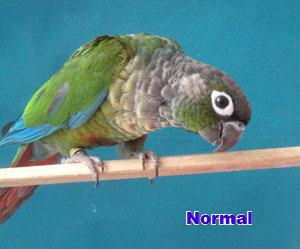
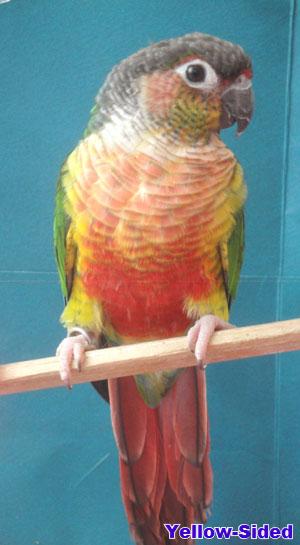
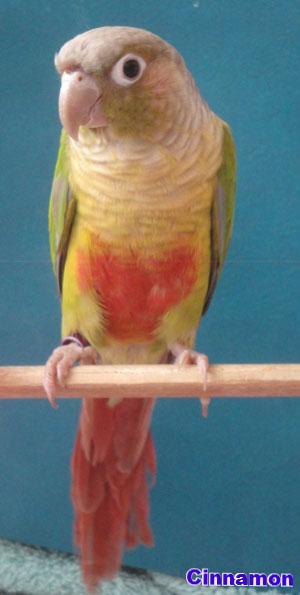
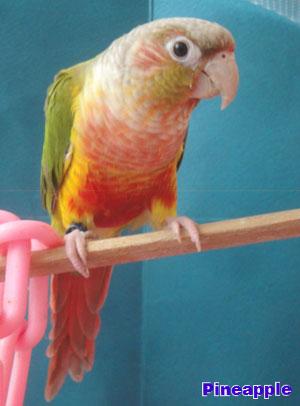
http://www.feathert.com/greencheekgenetics.html
http://www.avianweb.com/greencheekconure.html


http://www.avianweb.com/lovebirdinfo.htm
Lovebirds!
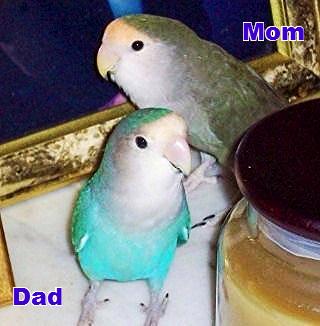
These small parrots (sometimes also referred to as "Pocket Parrot") have the intelligence and abilities of many of the larger parrots. They can also get quite bossy with other pets and even family members.Their voice apparatus allows a wide range of articulations, including the imitation of the human voice. Although they are not known to be great talkers; and most never learn to talk at all. If bonded to a human, they will make a very special pet indeed; ever loving as is true to its name. However, they do need a mate that spends significant time throughout the day with them - and in the absence of a bird mate - the bird owner has to fill this strong need for affection. A pet lovebird that is given little attention is probably one of the saddest sights I can think of. On the other hand, poorly socialized or even abused lovebirds are typically very aggressive - and gaining their trust and love is very time consuming. Not everybody is able to give this special bird the time commitment it needs.They make lively and energetic pet birds. They are available in a variety of colors and are playful and often boisterous birds. They require an owner who is willing to provide the care and attention this animated bird adores. Birds that do not receive this attention become prone to behavioral problems, including feather picking. Their lifespan is 10 to 15 years.
The parents of the baby lovebirds we get are named Sweet Pea and Skylar. They are owned by a friend, Mrs. Kathy, that gives them to us because they just cant stop them from having babies. They no longer have room for the babies and no longer have people to give them too. The mother, Sweet Pea, is a olive green slate peach faced. She is very smart. She can say good night, she whispers "baby". Can say drink, the si portion of Pepsi, stop it and laughs. The father, Sky is a dutch blue lovebird he is very sweet and does an excellent job of taking care of Sweet Pea and the babies till I'm able to pick them up and give them a break..
